

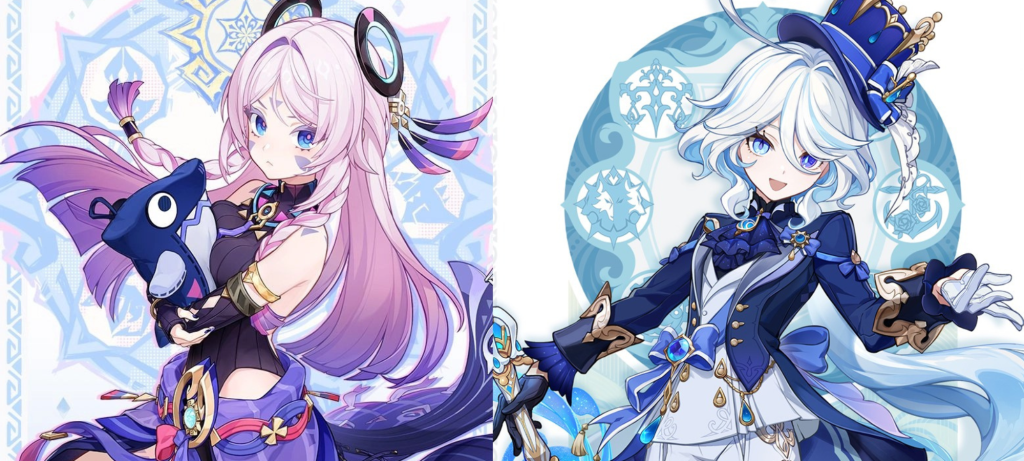
Amid the dual impact of globalization and the digital technology revolution, game character design has evolved beyond mere aesthetics to become a battleground for cultural symbolism and a testing ground for narrative strategies. Furina and Citlali from miHoYo’s open-world game Genshin Impact exemplify this trend. As the Hydro Archon of Fontaine, Furina deconstructs and reassembles French cultural elements, while Citlali, depicted as a shaman girl from Natlan, embodies a modern reinterpretation of exotic cultural motifs. Their costume designs act as prisms, reflecting miHoYo’s core “cultural collage” strategy — blending and reconfiguring cross-cultural symbols to construct characters with distinct worldviews while seeking a delicate balance between commercial appeal and artistic expression.

- Furina: A Playable Interpretation of French Culture
Furina’s costume design can be seen as a “playable cultural history of France.” As the Hydro Archon of Fontaine, her visual aesthetic blends elements of the French monarchy, opera artistry, and water motifs, forming a meticulously crafted symbolic system.
2. Metaphorical Reconstruction of Royal Symbols
Furina’s primary color scheme of Royal Blue directly references the visual identity of the French monarchy. In 17th-century France, blue dye was a symbol of nobility due to its rarity, and Louis XIV even designated it as a royal color. Furina’s gradient blue hair and gown not only evoke this historical memory but also reinforce her divine status through the dense use of fleur-de-lis patterns — a symbol of French royalty and the Holy Trinity since the medieval era.
Notably, Furina’s signature weapon, Tidal Shadow, combines the form of a European rapier with a scepter. The hilt’s fleur-de-lis engravings and the flowing water patterns along the blade not only retain the weapon’s functional design but also elevate it as a tangible symbol of divine authority.
3. Dynamic Representation of Opera Art
Furina’s obsession with opera is also woven into her costume design. The pleated structure of her gown mimics the dramatic drapery of an opera stage curtain, and the way the skirt moves while she walks mirrors the flowing rhythm of water.
Even more intricately, her heterochromatic eyes (left blue, right violet) and gradient hair simulate the play of stage lighting on a performer’s face. This design choice not only aligns with the operatic theme of “role-playing” but also hints at Furina’s dual identity — she is both the ruler of Fontaine and a perpetual performer on the grand stage.
4. Systematic Construction of Water Element Motifs
Furina’s costume intricately weaves a cohesive system of water element motifs. The blue-to-violet gradient in her hair symbolizes the merging of sea and waves, while the pearl accents on her gloves evoke foam and dewdrops. The wave patterns on the soles of her shoes serve as a direct nod to Fontaine’s aquatic theme.
Additionally, Furina ring, inspired by ocean waves, subtly integrates Hydro motifs in a refined and elegant design. The layered construction of her costume is particularly noteworthy: the faintly visible inner layer in pale blue contrasts against the deep blue outer gown. This visual tension between “confinement and release” artfully conveys Furina’s internal conflict — her struggle for control over her elemental power as the Hydro Archon.

5. Citlali: A Modern Reconstruction of Shamanic Culture
Unlike Furina’s “historical collage,” Citlali’s design focuses on a modern reinterpretation of shamanic culture. Her outfit blends Bohemian style, shamanic ritual elements, and youthful aesthetics, creating a fusion of “exotic charm” and “fashion-forward appeal.”
6. Fashionable Reinterpretation of Shamanic Symbols
Citlali’s feather accessories, woven belt, and metal rings are all derived from the primal beliefs of shamanism. Traditionally, feathers symbolize communication with spirits, woven belts represent binding natural forces, and metal rings are used for divination and rituals.
miHoYo strips these symbols of their religious context and transforms them into fashion elements: feathers become asymmetrical earrings, the woven belt serves as a waist accessory, and metal rings are reimagined as necklaces and bracelets. This transformation not only retains the mystique of shamanic culture but also infuses it with modern aesthetic value.
7. Subversive Expression of Youthful Aesthetics
Citlali’s outfit strikes a balance between her youthful charm and shamanic identity. The high-slit skirt and backless design highlight her silhouette, but flowing ribbons and long hair strategically obscure exposed skin, creating a subtle, sensual allure of “concealed yet revealed.”
Her color palette is equally contradictory: muted tones of pastel pink, lavender, and blue-violet evoke a “faded” look, symbolizing her resistance to the passage of time. Meanwhile, the stark white hood serves as a “protective shell,” contrasting sharply with her vibrant accessories and hinting at her inner isolation and struggle. This duality not only manifests in the game but is also vividly rendered in Citlali Figure, further solidifying her image as a modern shaman who embodies both girlish innocence and mystical power.
8. Symbolic Narratives of Natlan Culture
Citlali’s outfit is imbued with cultural motifs that reflect the heritage of the Natlan tribe. The geometric patterns on her clothing draw inspiration from Native American weaving, while the tasseled cords echo African tribal ornamentation. This cross-cultural collage of symbols subtly underscores Natlan’s worldbuilding as a convergence of diverse civilizations.
A particularly compelling detail is how her backline becomes prominent during combat — as Citlali unleashes her abilities, the feathered ornaments on her outfit sway with her movements, creating a visual effect akin to an “aura field.” This design not only pays homage to the shamanic tradition of “spirit dance” but also reinterprets it through the lens of Genshin Impact’s combat aesthetics.
9. The Narrative Function of Cultural Collage: From Symbols to Worldbuilding
The costume designs of Furina and Citlali are more than a mere assemblage of cultural symbols; they function as vital storytelling tools that deepen the integration between character portrayal and worldbuilding through miHoYo’s “cultural collage” strategy.
1. Furina: Visualizing the Struggle Between Divinity and Humanity
Furina’s costume details hint at the complexity of her identity. The juxtaposition of fleur-de-lis patterns and guillotine motifs — seen in the embroidered fleur-de-lis on her skirt and the blade-like patterns on her shoe soles — symbolises her dual role as a divine ruler who controls the fate of Fontaine yet remains powerless over her own destiny.
Her dual personality (Black Furina/White Furina) is also conveyed through her costume’s shifting color scheme: in her Black Furina form, the dark blue tones evoke suppression and intrigue; in her White Furina form, the return of royal blue signifies redemption and hope. This visual storytelling approach enables players to grasp her internal conflict without relying solely on text or dialogue.
2. Citlali: The Conflict and Reconciliation of Cultural Identity
Citlali’s evolving costume design reflects her journey of cultural identity. The pure white hood seen in the PV “Her Colors” represents her return to shamanic traditions, while the modern elements in her everyday attire (such as the off-shoulder design and metal accessories) suggest her gradual acceptance of the external world.
Her interactions with younger characters (such as sharing light novels with the Traveler) further demystify her shamanic identity, transforming it into a more approachable cultural symbol. This design strategy elevates her from a mere cultural token to a dynamic character with a narrative arc of personal growth.
3. The Commercial Logic of Cross-Cultural Collage
From a market perspective, the cultural collage strategy lowers the cognitive entry barrier for players. Furina’s French elements attract Western audiences, while Citlali’s shamanic motifs cater to the allure of “exotic mysticism.”
miHoYo strategically combines the familiar and the unfamiliar — such as merging French opera with Hydro motifs or fusing shamanic culture with youthful aesthetics — creating both accessibility and novelty.
This design philosophy extends to other characters in Genshin Impact, such as Zhongli’s “Chinese Punk” aesthetic in Liyue or Cyno’s “Academia Desert Chic” in Sumeru, establishing a distinctive methodology for character design that blends cultural references into compelling narratives.
- The Boundaries and Challenges of Cultural Collage
While miHoYo’s cultural collage strategy has achieved commercial success, it is not without controversy. In Furina’s design, some players have criticized the combination of fleur-de-lis patterns and guillotine motifs as a consumerist deconstruction of French history. Similarly, Citlali’s shamanic elements have faced accusations of “cultural appropriation.” These controversies expose a key risk of cultural collage: when cultural symbols are detached from their original contexts and recontextualized as entertainment products, how can one avoid diminishing or misinterpreting the source culture?
miHoYo’s response strategy involves dehistoricization and recontextualization. For instance, Furina’s storyline does not directly reference specific events in French history but instead employs metaphors (such as the “Calamity of Prophecies” as an allegory for pre-revolutionary societal crises) to evoke associations without explicit historical allusions. Similarly, Citlali’s shamanic identity is placed within the fictional continent of Natlan, maintaining a deliberate distance from real-world cultural contexts.
This approach preserves the allure of cultural symbols while mitigating the risk of controversy over specific historical references.
The costume designs of Furina and Citlali showcase miHoYo’s cultural creativity within the framework of globalization. By seamlessly blending historical symbols, regional cultures, and game narratives, miHoYo not only creates commercially compelling character designs but also explores new pathways for cultural dissemination in the digital age.
At the core of this “cultural collage” strategy is the transformation of cultural symbols into interactive narrative elements, allowing players to subconsciously absorb diverse cultural references through character development and storyline progression.
Looking ahead, as the world of Teyvat continues to expand, the key challenge for miHoYo’s global strategy will be striking a balance between cultural respect and creative reinterpretation.


