

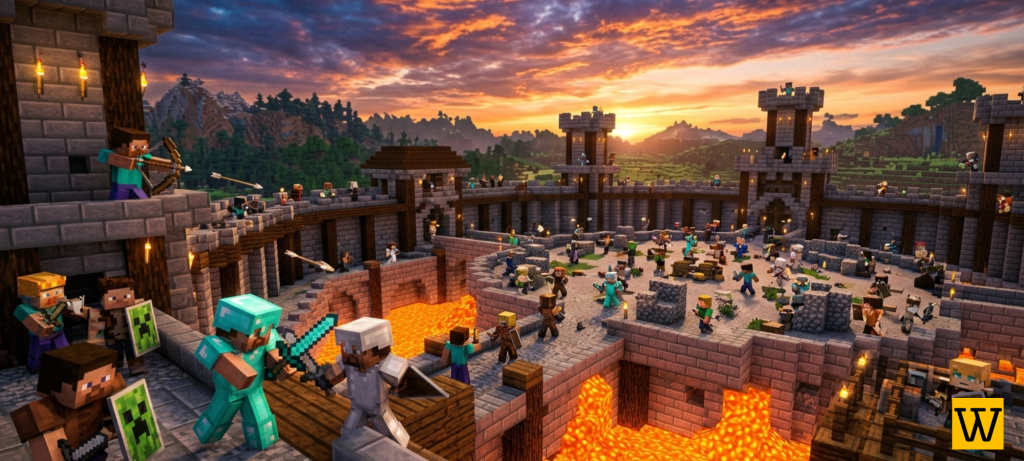
The phrase ideas playbattlesquare minecraft server might sound a little specific at first, but anyone who has spent time around multiplayer communities knows exactly why people search for it. Running a server is easy. Keeping players interested for weeks or months… that part is harder.
I’ve seen many servers launch with excitement and then quietly fade after a few months. Usually the issue isn’t performance or hardware. It’s the lack of fresh gameplay ideas. Players join, explore a bit, fight a few rounds, and then move on.
That’s why the idea behind a PlayBattleSquare-style server matters. It isn’t just about PvP. It’s about creating rotating experiences inside the same world so players always feel like there’s something new to try.
A lot of communities experimenting with these concepts build their ideas on the multiplayer mechanics of Minecraft, which allows custom worlds, mini-games, and community events to coexist in one server environment.
If you’re planning a server around the PlayBattleSquare concept, these ideas might help you build something players actually come back to.
The Core Idea Behind a PlayBattleSquare Minecraft Server
At its heart, the PlayBattleSquare concept is simple. Players gather in a central hub and jump into different battle-focused or survival-focused challenges. The map might change, the rules might shift, but the core loop stays familiar.
Players compete. Sometimes they cooperate. And every few minutes something new begins.
Servers inspired by networks like Hypixel Studios proved that variety matters more than a single game mode. People enjoy switching between activities without leaving the server.
So when people search for ideas playbattlesquare minecraft server, they’re usually looking for ways to build that variety.
Themed Battle Arenas That Feel Different Every Round
One of the easiest ways to keep players engaged is to create several battle arenas with completely different environments and mechanics.
Instead of using a single PvP map, imagine rotating arenas like:
Desert Fortress Battles
Desert fortress battles where players fight around sandstone towers.
Frozen Tundra Arenas
Frozen tundra arenas where ice physics makes combat unpredictable.
Jungle Ruins Maps
Jungle ruins maps with hidden pathways and vertical combat.
Each arena subtly changes how players approach fights. Some reward archery. Others favor melee combat or ambush tactics.
After a few rounds players begin recognizing maps and developing strategies. That sense of familiarity mixed with unpredictability is what makes competitive servers interesting.
I’ve noticed players often talk about their favorite arenas more than the server itself. That’s usually a good sign the design worked.
Micro Battle Build Fights
One idea that works surprisingly well is a short creative build phase followed by a sudden PvP match.
Players spawn on small islands with limited resources. They get about three minutes to build defenses, traps, or small bases. After that the fight begins.
The strategy element becomes fascinating.
Some players build defensive towers. Others rush into the fight immediately. Occasionally someone creates something ridiculous but effective like lava traps or hidden tunnels.
These short rounds keep the pace fast while still allowing creativity.
It reminds people why Minecraft became popular in the first place. Building and survival mechanics blend naturally with combat.
Mob Based PvP Kits
Another interesting direction is turning mobs into playable classes.
Instead of traditional PvP kits, players could choose abilities based on creatures from the game.

Blaze Class
Blaze class might shoot fireballs with limited charges.
Spider Class
Spider class could climb walls and perform quick ambush attacks.
Witch Class
Witch class could throw splash potions that disrupt enemies.
This system mirrors hero-style multiplayer games but still fits naturally within Minecraft mechanics.
Players often enjoy experimenting with different classes and discovering unexpected combinations.
The funny thing is that sometimes the weakest-looking class becomes the most dangerous once someone figures out a clever strategy.
Competitive Survival Events
Most PvP servers focus only on combat. But survival competitions can be just as exciting.
A concept sometimes discussed in server communities is something called Abba Caving.
Players enter a large cave system and have a limited amount of time to gather resources. Everything collected belongs to the player who survives the round.
But if someone dies during the event, their items drop and others can claim them.
It becomes a strange mix of exploration, greed, and risk management.
You can see similar community event discussions in development forums like SpigotMC where server owners share gameplay experiments.
Events like these often produce the most memorable moments because they create unexpected player stories.
Ultra Hardcore Battle Modes
Another popular idea that fits the PlayBattleSquare theme is Ultra Hardcore matches.
In UHC rules, natural health regeneration is disabled. Players must rely on golden apples or potions to heal.
This small rule change completely transforms combat.
Players become cautious. Every hit matters. Resource management suddenly feels intense.
Now imagine running short UHC rounds inside a shrinking map arena.
The tension builds quickly. Players know that one mistake might end the match.
And because the rounds are short, losing doesn’t feel frustrating. It just encourages another attempt.
Mystery and Role Based Game Modes
Some servers experiment with social deduction mechanics inspired by games like Mafia.
Players receive secret roles when the round begins.
One player might be the antagonist trying to eliminate others quietly. Another might be a detective searching for clues. Everyone else is simply trying to survive.
The environment becomes part of the puzzle.
Hidden clues, secret passages, and trap mechanisms can turn simple maps into detective playgrounds.
These modes slow the pace slightly compared to PvP, but they create strong player interaction.
And honestly, those conversations after a round can be hilarious.
Someone always accuses the wrong person.
Escape Room Style Challenges
Escape room concepts work surprisingly well in Minecraft if designed carefully.
Teams enter puzzle chambers filled with redstone mechanisms, hidden levers, and coded clues.
The objective is simple. Escape faster than the other teams.
But the puzzles can vary widely.
Pattern Recognition Puzzles
Pattern recognition puzzles.
Hidden Button Hunts
Hidden button hunts.
Logic Doors
Logic doors powered by redstone circuits.
These challenges reward players who enjoy thinking rather than fighting.
That balance matters. Not everyone joining a server wants constant combat.
PvE Raid Bosses and Mob Arenas
A server doesn’t always need player-versus-player conflict.
Cooperative PvE arenas can become a central attraction.
Players enter an arena and fight waves of increasingly powerful mobs. Eventually a custom boss appears.
Boss abilities could include teleportation, lava attacks, or summoned minions.
Players must coordinate roles like tanking, damage, and healing.
This type of gameplay builds community because players naturally form teams.
Some servers even introduce seasonal bosses that appear during special events.
Over time players begin collecting unique items or cosmetics from these encounters.
Scavenger Hunt Storylines
A less common but fascinating idea involves server-wide scavenger hunts.
Instead of simple item collection quests, the server includes hidden books, ancient ruins, and lore scattered across the map.
Players slowly piece together a story as they explore.
I’ve seen communities spend weeks trying to solve puzzles hidden in structures.
Some clues lead to secret areas. Others reveal fragments of the server’s fictional history.
When done well, this transforms the world from a game map into something that feels alive.
If you enjoy reading about gaming communities and server creativity, platforms like EuroGamersOnline.com often highlight how multiplayer environments evolve around player-driven ideas.
Technical Ideas That Improve Gameplay
Sometimes the best ideas playbattlesquare minecraft server owners can implement aren’t game modes at all.
They’re systems.
Rotating Event Scheduler
A rotating event scheduler that launches mini-games automatically.
Reputation Systems
A reputation system rewarding helpful players.
Seasonal Map Resets
Seasonal map resets that refresh exploration.
These small features keep servers feeling active even when gameplay itself doesn’t change dramatically.
Server owners often overlook these details, but players notice them.
Puzzle Mechanics and Brain Challenges
Not every challenge needs combat or survival.
Some communities enjoy puzzle-focused gameplay.
Timed logic rooms, maze races, or pattern challenges can offer a break from fighting.
Puzzle mechanics also connect well with communities that enjoy thinking through problems rather than reacting quickly.
Writers and puzzle designers like Lore Pemberton often explore the psychology behind puzzles, and that same idea applies to Minecraft environments.
Players feel satisfaction when they solve something clever.
People Also Ask
What is a PlayBattleSquare Minecraft server?
A PlayBattleSquare Minecraft server usually refers to a multiplayer environment where players compete in various battle arenas, mini games, and survival challenges inside one central hub. The concept focuses on variety rather than a single gameplay mode.
How do you make a Minecraft battle arena server?
Most battle arena servers start with a hub world where players select game modes. Map designers create custom arenas while plugins manage matchmaking, score tracking, and player abilities. Server software like Spigot or Paper is commonly used.
What game modes work best for Minecraft servers?
PvP arenas, survival competitions, parkour challenges, puzzle rooms, and cooperative mob battles tend to perform well. The key factor is variety so players always have another activity to try.
How much RAM does a Minecraft server need?
Small servers might run with around 2 to 3GB of RAM. Larger communities with multiple mini games often require 5GB or more depending on player count and plugins.
Why do some Minecraft servers fail quickly?
Many servers launch with only one or two activities. Once players experience everything available, there is little reason to stay. Servers that succeed usually rotate events, introduce seasonal updates, and maintain strong community interaction.
Final Thoughts
Thinking about ideas playbattlesquare minecraft server design always brings me back to the same observation.
Players rarely remember the mechanics first.
They remember moments.
The chaotic fight where someone triggered a trap too early. The puzzle room that took thirty minutes to solve. The survival round where a single player escaped with all the resources.
Those unpredictable experiences are what turn a simple server into a place people revisit.
And maybe that’s the strange part of Minecraft multiplayer. You can build hundreds of systems, arenas, and mechanics… but the real game always seems to happen between players themselves.


