


Golf can be an incredibly intimidating sport for the uninitiated. When you stand on the first tee of a championship course, looking down a 500-yard fairway with water on the left and sand on the right, the “fun” factor can quickly evaporate into a cloud of frustration. This is precisely where the par 3 golf course enters the frame. It is the perfect entry point for the novice, a sanctuary for the busy professional, and a high-stakes training ground for the seasoned pro.
But what exactly is a par 3 golf course, and why has it become the fastest-growing segment of the golf industry in 2026? Whether you are looking to shave strokes off your handicap or just want a low-pressure way to enjoy a Sunday afternoon with the family, understanding the mechanics of these “short courses” is your first step toward better play.
Table of Contents
- Defining the Par 3 Golf Course: The 3-Stroke Rule
- Why Size Matters: Distance and Layout
- What Is a Par 3 Golf Course Called? (Common Names)
- The Strategy: Why You Don’t Need a Driver
- Who Should Play a Par 3 Course?
- Par 3 vs. Regulation Courses: A Comparison
- The Benefits: Speed, Cost, and Skill
- What to Pack in Your Bag
- FAQ:
- Final Thoughts: Is a Par 3 Course Right for You?
Defining the Par 3 Golf Course: The 3-Stroke Rule
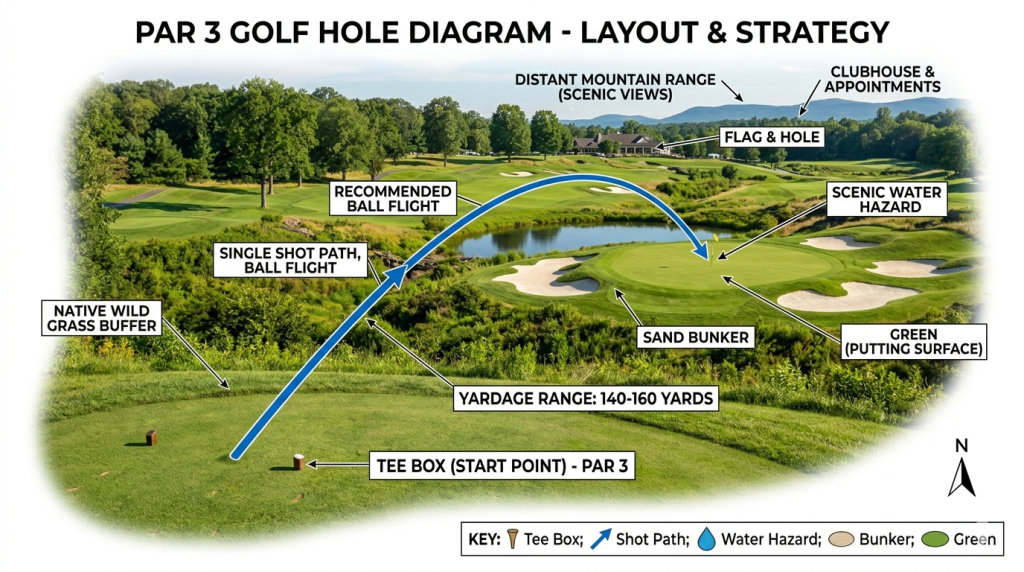
At its most fundamental level, a par 3 golf course is a specialized layout where every single hole on the scorecard is a par 3. In the world of golf scoring, “par” represents the number of strokes an expert golfer is expected to need to complete a hole. For a par 3, the math is simple: you are expected to reach the green with your very first shot (the tee shot) and then take two putts to get the ball into the hole.
Unlike a standard “regulation” course—which features a mix of par 3s, par 4s, and par 5s—the par 3 course removes the long-distance grind. You won’t find any 600-yard monsters here. Instead, you find a series of precision challenges that test your ability to hit a specific target from the start.
Why Size Matters: Distance and Layout

When people ask, “what is a par 3 course in golf,” they are usually asking about the distance. On a traditional course, a par 3 hole might occasionally stretch to 240 yards. However, on a dedicated par 3 course, the distances are much more manageable.
Typically, the holes will range from 70 yards to 200 yards. In 2026, many modern “short courses” are designed by famous architects to mimic the most iconic holes in the world, just on a smaller scale. You might find a 9-hole layout that takes very little time to play, or a full 18-hole par 3 course that offers all the beauty of a major resort without the exhaustion of a five-hour round.
What Is a Par 3 Golf Course Called?
Language in golf can be a bit regional, leading many to ask, “what is a par-3 golf course called?” While “par 3 course” is the most common term, you will frequently hear them referred to as:
- The Short Course: This is the most popular alternative name, used by world-class resorts.
- Pitch and Putt: Usually refers to a very short par 3 course where holes are under 100 yards and players primarily use wedges.
- Junior Course: Often used when the course is specifically designed with younger players in mind.
The Strategy: Why You Don’t Need a Driver
One of the most liberating aspects of playing a 3 par golf course is leaving the big “dog” at home. The driver is notoriously the most difficult club in the bag to hit straight. On a par 3 course, accuracy is the only currency that matters.
The strategy here is about iron play and wedge control. Since you are trying to land the ball on a green that is only 100 or 150 yards away, you are focused on “club selection.” Do you hit a smooth 7-iron or a hard 8-iron? This mental chess match is exactly what makes serpent cube puzzles so addictive—it’s about finding the right fit for the space provided.
Who Should Play a Par 3 Course?
The beauty of this format is its inclusivity.
- Beginners: It is the ultimate “no-judgment” zone. You don’t have to worry about hitting a 200-yard drive just to reach the fairway.
- The “Short Game” Junkie: Statistics show that 60% of golf shots happen within 100 yards of the hole. If you want to lower your score on a big course, you practice on a small one.
- Families: It is the perfect environment for a social outing. Much like sitting around a game and puzzle table, a par 3 course encourages conversation because everyone stays close together.
Par 3 vs. Regulation Courses: A Comparison
| Feature | Par 3 Course | Regulation Course |
| Total Par | 27 (for 9 holes) | 70–72 (for 18 holes) |
| Average Time | 1 – 2 Hours | 4 – 5.5 Hours |
| Primary Clubs | Irons, Wedges, Putter | Full Bag (Driver to Putter) |
| Cost | Budget Friendly | Premium |
The Benefits: Speed, Cost, and Skill
In 2026, time is the most valuable commodity we have. One of the biggest hurdles for new players is How Long Does a Game of Golf Take, but the par 3 course solves this. You can play 9 holes during a lunch break or after work before the sun goes down.
Additionally, the cost of entry is significantly lower. Maintenance for a par 3 course is cheaper because there are no massive fairways to mow, and those savings are passed on to you. It’s the “budget-friendly” luxury of the sports world.
What to Pack in Your Bag
You don’t need a massive tour bag for this. In fact, many players use a “Sunday Bag”—a small, lightweight carry bag.
- Irons: Usually 5-iron through 9-iron.
- Wedges: A Pitching Wedge and a Sand Wedge are essential.
- Putter: The most important club on any course.
- The “Essentials”: A few balls, some tees, and a repair tool for the greens.
FAQ:
What is a 3 par golf course for?
It is primarily for practicing the “short game” (approaches and putting) and providing a faster, more accessible version of the game for beginners.
Do par 3 courses count toward your handicap?
In many jurisdictions, yes! As long as the course is officially rated by a golf association, you can post your scores to your handicap index.
Can I use a tee on every hole?
Yes. Even though you are hitting irons, you are allowed to use a tee on the teeing ground of every hole. This ensures a “perfect lie” and makes the game easier for beginners.
What is the hardest part of a par 3 course?
The greens are often smaller and more guarded by bunkers. Because the holes are short, designers make the greens “trickier” to keep the challenge high. It’s like solving a complex logic puzzle—one wrong move at the start makes the finish much harder.
Final Thoughts: Is a Par 3 Course Right for You?
If you have ever felt overwhelmed by the “bigness” of golf, the par 3 course is your answer. It strips the game down to its most rewarding elements: the flight of the ball, the click of a well-struck iron, and the roll of a perfect putt.
Whether you call it a “short course” or a “par 3,” the result is the same: more fun in less time. In a world that’s increasingly fast-paced, sometimes going small is the best way to win big.
For more information on course design and the evolution of the game, you can explore resources from the American Society of Golf Course Architects or check out the latest equipment reviews at Golf Digest.


