


What is a passing grade? It’s the minimum mark you need to finish a course, exam or assignment successfully and earn credit for it. In a lot of US schools that means a D, or roughly 60%. But that’s a common pattern, not a rule everyone follows. Your school, your course and even your major can move the line.
This guide walks through the usual percentage and letter scales, how high school and college differ, what happens in other countries, and how a low pass can still hurt your GPA. By the end you’ll know where to look for the number that actually applies to you.
What Is a Passing Grade, Exactly?
A passing grade is the lowest result a school accepts as “you met the standard.” Hit it and you usually get course credit. Miss it and you get a fail, which often means repeating the class. The Cambridge Dictionary defines it as the number of points you need to succeed in an exam, and that’s about as simple as it gets.
The tricky part is that “passing” can mean different things at once. You can pass a class and earn credit, yet still not meet the requirement for your major. You can pass every course and still fall below the GPA your school expects. So think of a passing grade as the first hurdle, not the finish line.
What Percentage Is a Passing Grade?
Most US schools use some version of the A to F scale. Here’s the one you’ll see most often:
| Letter grade | Common percentage | What it usually means |
|---|---|---|
| A | 90–100% | Excellent |
| B | 80–89% | Good |
| C | 70–79% | Satisfactory |
| D | 60–69% | Low pass in many systems |
| F | Below 60% | Fail on this scale |
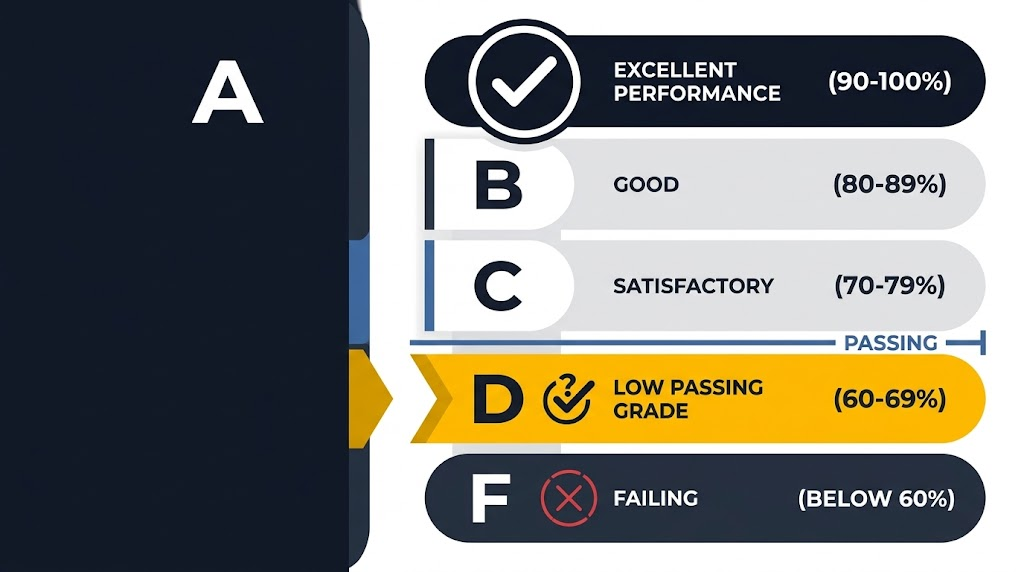
Treat this as an example, not a universal standard. Some schools use plus and minus grades, so a B+ or a C- has its own cutoff. Others set the pass line at 65% or 70%. Your syllabus or school grading policy always beats a chart you found online, including this one.
Is 60% a Passing Grade?
In many US schools, yes. A 60% often lands as a D, and a D is often the lowest passing grade. That’s why 60 shows up in so many search results.
But “often” isn’t “always.” Some schools draw the pass line at 65% or 70%. Some college programs want a C or better in certain courses, which means a 60 wouldn’t count there even though it might earn credit in an elective. So if you’re sitting at 61% the night before finals, don’t rely on a general rule. Open your syllabus and check.
Is 70% a Passing Grade?
Almost everywhere that uses the standard scale, 70% is a C, and a C is a pass. It’s also the grade many programs treat as the safe minimum for major courses. So if you’re asking “is 70 passing a class,” the answer is very likely yes. The few exceptions are schools with unusually strict scales, which is another reason to confirm in your course outline.
Is a D a Passing Grade?
Technically, often yes. A D usually covers 60 to 69% and, at many schools, still earns course credit. You won’t be forced to retake it just because it’s a D.
Here’s where students get caught, though. Credit and requirements are two separate things:
| Situation | Is a D enough? |
|---|---|
| General elective | Often yes |
| Course required for your major | Depends on the program |
| Prerequisite for the next class | Check the next course’s rules |
| Graduate program | Frequently no, many want a C or higher |
| Professional or licensing course | Depends on the program and regulator |
Picture this. You get a D in an elective and it counts. You get a D in a core course for your major, and the department says it needs a C. Same grade, two different outcomes. That’s an illustration, not a policy at every college, but it happens often enough that you should never assume.
What Is a Passing Grade in High School?
Most US high schools treat 60% (a D) as the lowest passing mark, though some districts raise it to 65% or 70%. State and district rules decide this, so two schools a few miles apart can be different.
A few things worth knowing:
- Some subjects or programs, like honors tracks, may ask for a higher grade to continue.
- Passing a class gets you the credit for that class. It doesn’t guarantee you’ve met graduation requirements.
- You might pass everything and still be short on required courses or total credits.
If you’re a parent trying to work out where your child stands, the school’s grading handbook is the quickest place to confirm. And if you’re still deciding which school is right for your kid, this guide on choosing a school for your child covers the questions worth asking up front.
What Is a Passing Grade in College?
College is where things split apart. Many colleges accept a D, or even a D-minus, as the lowest passing grade for general credit. A lot of departments, though, want at least a C for courses in your major, and some courses only count toward your degree if you hit that bar.
Prerequisites add another layer. If a course is the first in a sequence, the next class may require a C or better before you can enrol. You could “pass” the first one and still get blocked from the second.
Your cumulative GPA matters too. Many undergraduate programs expect a 2.0 to stay in good standing, and many graduate programs expect a 3.0, but those numbers vary by school and program. Professors and grading styles differ a lot as well. If you want a feel for what a course is like before you sign up, student reviews on a site like Rate My Professor can help, as long as you take individual opinions with a grain of salt.
Passing Grades in Middle School and Elementary School
Younger students are graded in different ways. Plenty of elementary schools skip letter grades altogether and use progress levels like “meeting expectations” or “approaching.” Middle schools often mix tests, homework, projects and participation into one overall mark.
Because of that, there’s no single national pass percentage for these years, and anyone who gives you one is guessing. The U.S. Department of Education sets broad federal guidance, but grading policy itself is decided by states and districts. The best source is the school’s report card guide or student handbook, or just a quick question to your child’s teacher.
Passing Grades Around the World
A pass mark in one country doesn’t translate neatly to another. These are common reference points, not guarantees:
| Country | Common reference point | Keep in mind |
|---|---|---|
| United States | Around 60% in many school and college systems | Depends on the institution and course |
| United Kingdom | 40% is a common undergraduate pass mark | Degree level and university rules matter |
| Australia | 50% is commonly linked to a Pass | Universities set their own policies |
| Canada | No single national threshold | Province, school and university all differ |
A 40% in the UK and a 60% in the US aren’t “worse” or “better” than each other. Marking styles, exam difficulty and degree classifications are all different. So if you’re applying abroad, check the specific university’s regulations rather than comparing raw percentages.
How Does a Passing Grade Affect Your GPA?
This is the part many students overlook. Passing a course and protecting your GPA are not the same goal.
GPA is built from grade points. On a common four-point scale it looks like this (plus and minus grades and exact values vary by school):
| Letter grade | Example grade points |
|---|---|
| A | 4.0 |
| B | 3.0 |
| C | 2.0 |
| D | 1.0 |
| F | 0.0 |
Say you take a three-credit course and earn a D. At 1.0 point per credit, that course adds 3 quality points. A C in the same course would add 6, and a B would add 9. You passed, but the course pulled your average down compared with a higher grade.
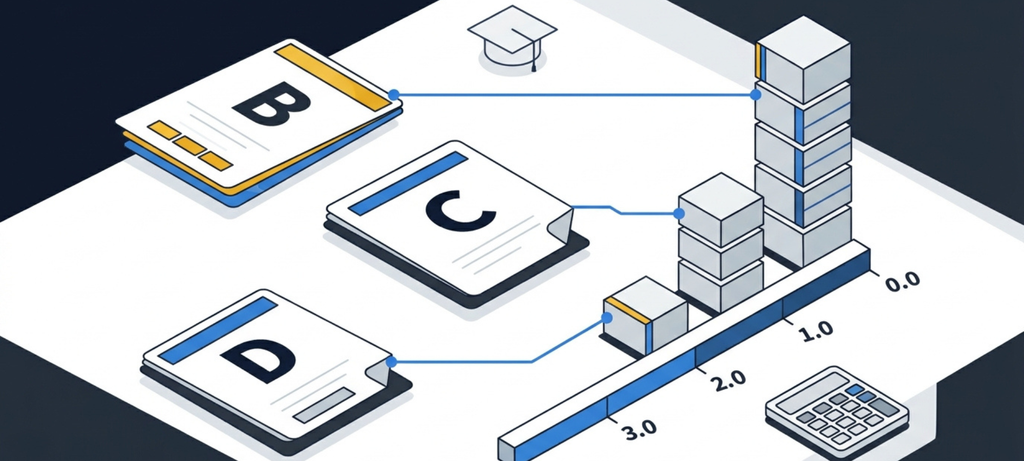
Stack up a few D’s in one semester and your cumulative GPA can slip under the level your school expects, even though you technically passed everything. That can lead to academic probation or a warning, depending on the school.
When a Passing Grade Isn’t Enough
A pass earns credit. It doesn’t always satisfy every rule that sits on top of it. Here’s where “passing” quietly means something stricter:
- Prerequisites: the next course may need a C or better.
- Major requirements: departments often set their own minimums.
- Professional programs: fields like nursing or engineering can have tougher course standards.
- Graduate school: many programs expect a C or higher in every class, plus a minimum GPA.
- Scholarships and financial aid: they often come with GPA conditions that a string of low passes can break.
- Graduation and progression: you may need a certain cumulative GPA to move forward or finish.
Before you relax about a D, find out whether that course falls into any of these buckets.
What Is Pass/Fail Grading?
Some schools let you take certain classes pass/fail instead of for a letter grade. You get a “pass” or a “fail,” and the result may not count toward GPA at all.
The catch is that the pass line for these courses can be higher than you’d guess. At some schools a pass/fail “Pass” needs a C or above, so a D that would count in a normal letter-graded class might not count here. Other schools set it differently, so read the policy before you opt in. Pass/fail courses can also have separate rules about whether they count toward your major or general requirements.
What Happens If You Don’t Get a Passing Grade?
Failing a class feels awful, but it’s rarely the end of the road. Depending on your school, your options may include:
- Retaking the course
- Talking to your instructor about where things went wrong
- Meeting an academic advisor
- Using tutoring centres, study groups and office hours
- Withdrawing before the deadline, which usually gives you a W instead of an F
- Asking about grade replacement or academic forgiveness, if your school offers it
None of these are guaranteed. A withdrawal might not touch your GPA, but it can still affect your progress toward completion or your financial aid. And grade replacement exists at some schools and not others. Ask early, before the deadline passes, not after.
A Quick “What Should I Check?” List
If you take one thing from this article, make it this checklist:
- Read the course syllabus for the minimum pass percentage or letter.
- Check whether your major or program requires a C or higher.
- Look at prerequisite rules for the next course in the sequence.
- Find out the cumulative GPA you need to stay in good standing.
- Ask an academic advisor if anything is unclear.
Frequently Asked Questions About Passing Grades
Is 60% a passing grade?
In many US schools, yes, and it often equals a D. Some schools and programs set a higher bar, so confirm in your syllabus.
Is 70% a passing grade?
Usually yes. On the standard scale, 70% is a C, which counts as passing almost everywhere.
Is a D a passing grade?
Often, yes. It typically earns credit, but many majors, prerequisites and graduate programs want a C or better.
What percentage is considered failing?
Below 60% is failing on the most common US scale. Some schools set the fail line at 65% or 70%.
What is a passing grade in high school?
Commonly 60% (a D), though some districts require 65% or 70%. State and district policy decides.
What is a passing grade in college?
Many colleges accept a D for general credit, but major courses and prerequisites often need a C or higher.
Does a passing grade count toward college credit?
Usually yes, but credit alone may not satisfy a major or program requirement.
Can you pass a class but still miss your GPA requirement?
Yes. A low pass like a D adds fewer grade points, and several of them can drop your cumulative GPA below what your school expects.
What’s the difference between a passing grade and a good grade?
A passing grade is the minimum to earn credit. A good grade is one that keeps you competitive for your major, scholarships or graduate school.
Is a C considered a passing grade?
Yes. A C is a pass nearly everywhere, and it’s the minimum many programs ask for in key courses.
Final Thoughts
So, what is a passing grade? It’s the minimum result that earns you credit, and in many US schools that’s a D or around 60%. But the real number depends on your school, your course, your program and your country. Don’t lean on a figure from a random website, this one included. Check your syllabus, your handbook or your advisor, and aim a little above the bare minimum so one bad week doesn’t cost you more than a grade.


